Tax-inclusive reference prices in CNY. Negotiable; the quotation reflects the selected configuration, quantity and delivery requirements. All products carry a 3-year warranty.
For a complete system, include the power supply, sensors, communication access and platform deployment in your enquiry.
At a glance
Outputs2 control channels
Inputs2 external inputs
DataVoltage, current, power and accumulated energy
ManagementMobile and Web
Product overview
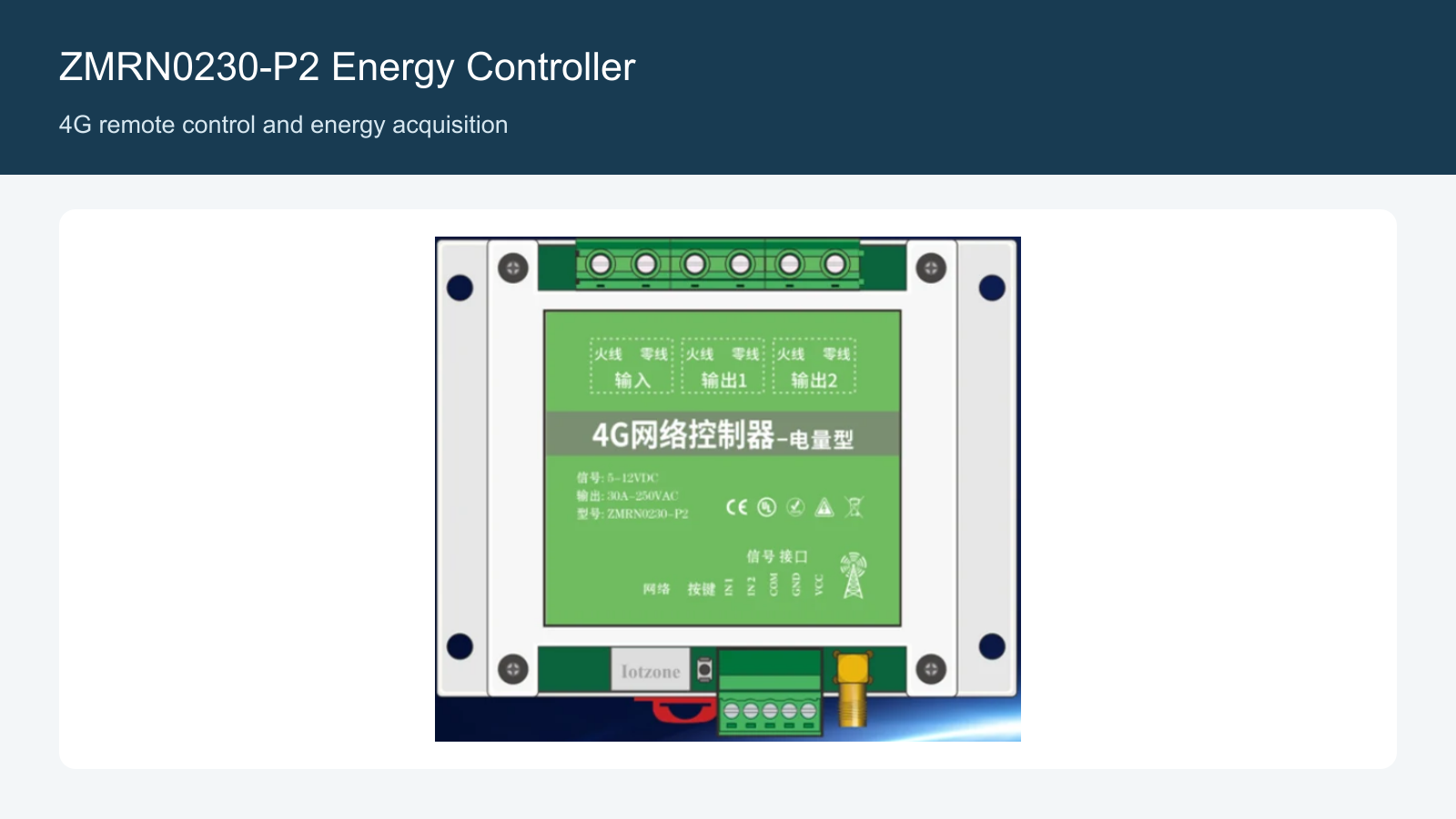
P2 serves small equipment installations requiring switching and energy visibility together. Name each circuit and correlate operations with changes in electrical demand.
Functions and integration
Per-circuit data
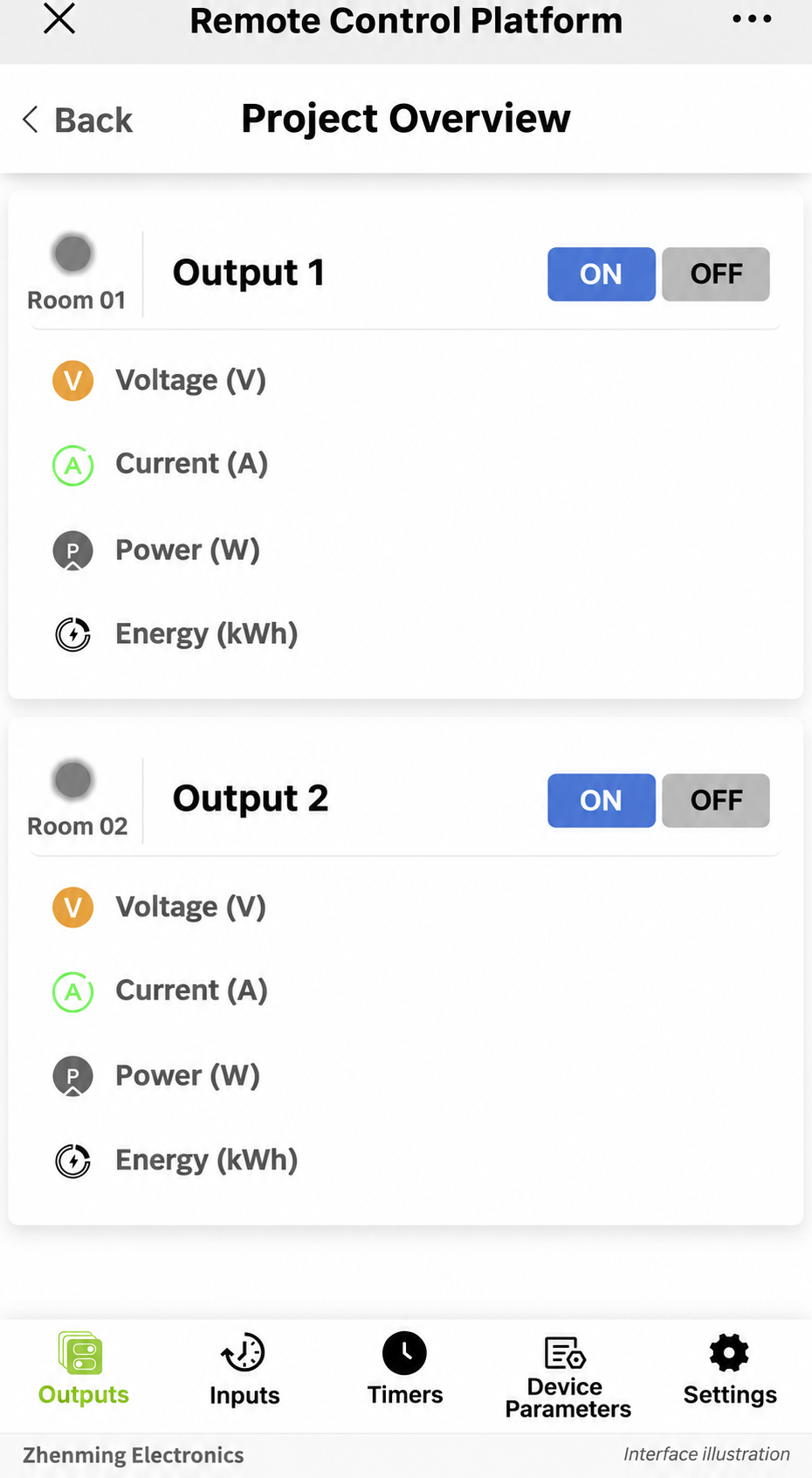
Operate each output and view voltage, current, power and accumulated energy.
Local inputs
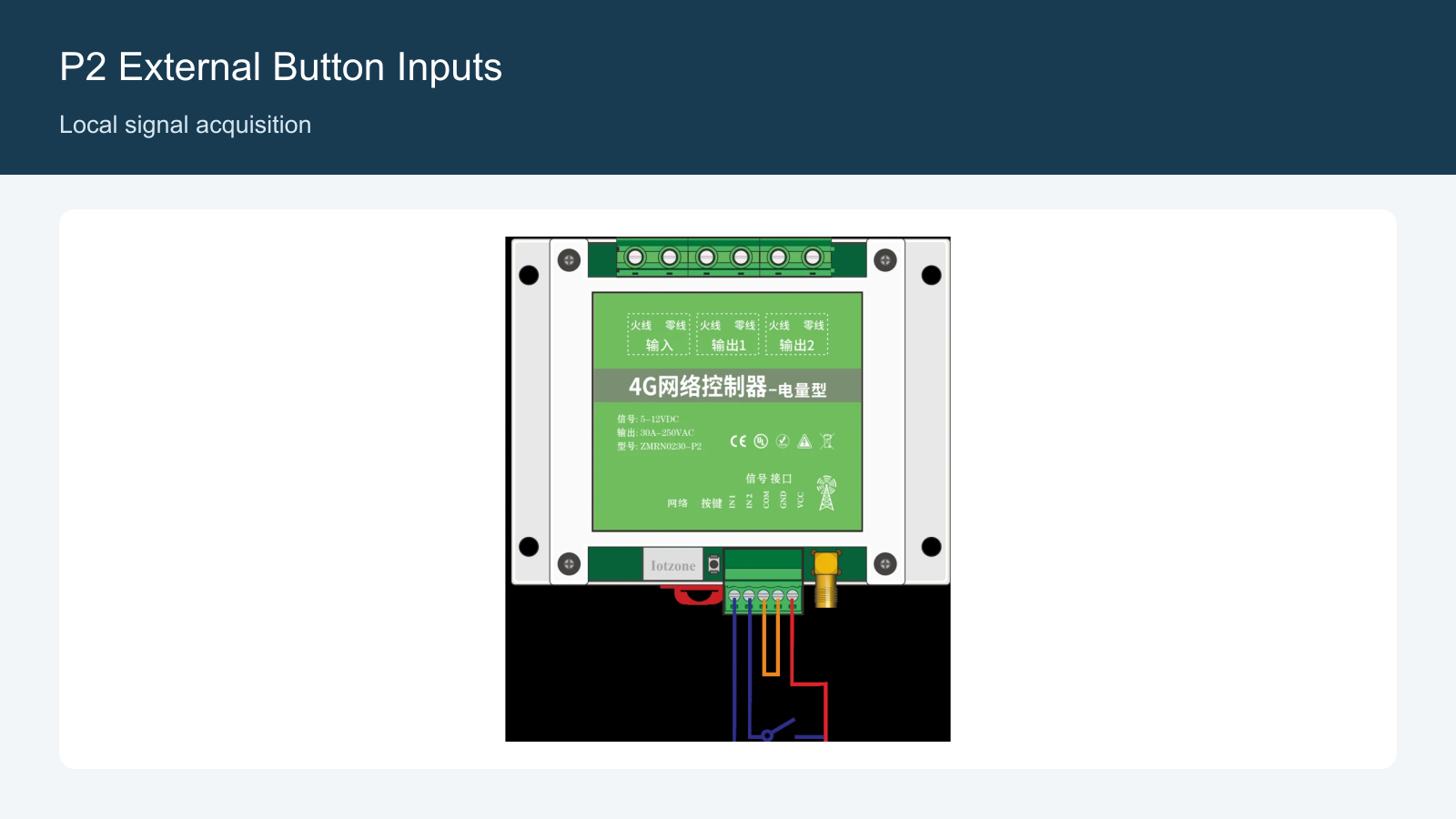
Compatible external buttons or contacts provide field operation alongside remote access.
Output behavior
Switching, pulse, toggle, interlock and hidden-channel modes support different control tasks.
Communication selection
Choose the 4G or Ethernet version for the site; these are version choices rather than two guaranteed interfaces on one unit.
Applications and operating workflow
Stores
Separate signage and indoor lighting while reviewing energy trends.
Auxiliary equipment
Combine commands and operating observations for appropriately designed pump, fan or cabinet circuits.
Technical data and interfaces
Outputs
2 control channels
Inputs
2 external inputs
Data
Voltage, current, power and accumulated energy
Management
Mobile and Web
Communication
4G or Ethernet version
Dimensions
Approximately 115×100×40mm
SNMP versions (Ethernet)
v1/v2/v3
Optional Ethernet protocols
BACnet/IP, EtherNet/IP (optional)
Selection and system combinations
Dual-circuit energy control combines switching with power measurements. Compare ER1 for single-circuit 4G energy control and branch acquisition products for additional metering circuits.
Choose an energy relay when one circuit needs both 4G switching and power data. Compare a switching-only controller for simple start/stop duties, or a multi-circuit energy controller for additional circuits.
Use the module for separate single-phase branch measurements rather than only a distribution total. Plan branches, current transformers and reporting dimensions; compare three-phase systems for whole three-phase loads.
Name each circuit for its purpose, such as signage, interior lighting, a fan or auxiliary equipment, then review switching, voltage, current, power and accumulated energy separately. Relating a command to the subsequent demand change supports review of operating hours, standby use and differences between circuits. Keep names aligned with panel labels for mobile and desktop teams.
P2 interface with two-channel switching, voltage, current, power and energy
02
Coordinate field inputs with output behavior
Two external inputs preserve local operation through compatible buttons or switches. Maintained switching, pulse, toggle and interlock modes cover different command patterns. Map both platform commands and field inputs to the same circuit model. For pump, valve or equipment commands, organize the switching path and operating feedback separately so the request can be distinguished from actual conditions.
External button wiring for the P2 dual-channel energy controller
03
Select connectivity and schedules for each site
Choose the Ethernet version for a cabinet with a fixed LAN or the 4G version for a distributed site. Organize opening hours, ventilation periods or equipment warm-up by circuit and time. Mobile access supports temporary operation and desktop access supports multiple devices. Expand by zone while keeping each circuit purpose, connectivity version and energy reference clearly defined.
04
Ethernet protocols and system integration
P2 Ethernet variants support SNMP v1/v2/v3; BACnet/IP and EtherNet/IP are optional protocol capabilities for project integration.
Selection questions
How can demand be reviewed after remote switching?
Review the command record with current, power and accumulated energy on that circuit. Separate input feedback can add contactor state or mechanical-position information.
Can the two circuits serve different purposes?
They can be named and managed separately, such as signage and interior lighting or two auxiliary devices. Match each circuit load, output mode and external input to its function.
Which SNMP versions are supported, and are BACnet/IP and EtherNet/IP optional?
P2 Ethernet variants support SNMP v1/v2/v3; BACnet/IP and EtherNet/IP are optional protocol capabilities for project integration.
Frequently asked questions
Can Q2 specifications be used for P2?
No. Use the P2 specifications and interface definition.
Is the energy data a billing measurement?
The described functions support operating monitoring; billing requires a suitable metering configuration.