IoT Centralized Management Client
The client centralizes device management while field hardware performs control and acquisition. Existing business systems can use platform API integration; local room operations can use RoomCtr.
View product detailsHTTP, MQTT and Webhook integration for device queries, asynchronous commands and device-message callbacks, with callback verification, HMAC-SHA256 signatures and delivery retries.
Tax-inclusive reference prices in CNY. Negotiable; the quotation reflects the selected configuration, quantity and delivery requirements. All products carry a 3-year warranty.
For a complete system, include the power supply, sensors, communication access and platform deployment in your enquiry.
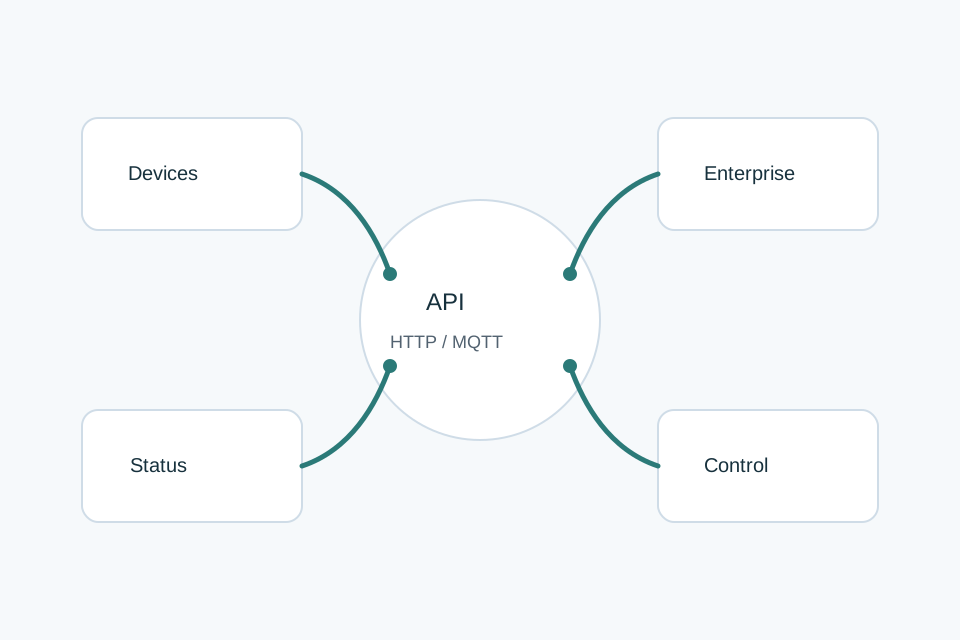
HTTP, MQTT and Webhook integration for device queries, asynchronous commands and device-message callbacks, with callback verification, HMAC-SHA256 signatures and delivery retries.
The page is written for engineering companies, system integrators, device manufacturers and B2B project procurement teams.
Submit a command without waiting for the device response. Webhook delivers device messages to your server, with callback verification, HMAC-SHA256 signatures and delivery retries. A successful publish response confirms command submission; the device result arrives through the callback.
Use the API to connect device data and control operations with a business system. Define business events, device models and data direction; use the platform client when an operator interface is required.
The client centralizes device management while field hardware performs control and acquisition. Existing business systems can use platform API integration; local room operations can use RoomCtr.
View product detailsSelect a Q-series configuration by circuit count, load type and site network. Compare 4G models for cellular access and the high-power range for higher-load circuit control.
View product details| Integration interfaces | HTTP API, Webhook callbacks and persistent MQTT connections |
|---|---|
| Main functions | Device queries, synchronous/asynchronous control, device-message push, callback signatures and delivery-status queries |
| Applicable devices | IoT relays, 4G controllers, industrial IO, acquisition terminals and other platform-connected devices |
| Integration applications | Enterprise platform integration, private deployment, system integration and remote operations |
No. Acceptance and execution are different stages. Use device messages, state queries and the project acknowledgement model to confirm the outcome.
The receiver should process messages idempotently by event or business key, alongside signature checks and logs.
Group sites, buildings and equipment and assign operator scopes by role.
Connect abnormal conditions, operations and recovery records with authorized video and business interfaces.
Call us or leave your contact details for product selection and project enquiries.
Call us+86 16605298829Taobao Store ↗Open the Zhenming IoT platform, product documentation or official Taobao store.