Zhenming Electronics
Engineering guide · Communication · Automation · Energy

Industrial IoT Communication, Automation and Power Acquisition Selection Guide

A practical framework for system integrators choosing field communication, local automation, platform access and power acquisition. Start from the managed object and operating requirement, then select devices and protocols.

4communication options compared
Localtime-sensitive field execution
Cloudvisibility, records and operations
Powermetering and quality analysis

Start with four project questions

What is managed?Lighting circuits, pumps, fans, valves, sensors, meters or existing equipment.
Where should decisions run?Separate time-sensitive local control from cross-site platform management.
What network exists?Confirm cable routes, LAN, cellular signal, wireless coverage and maintenance ownership.
What data is required?Define control feedback, reports, alarms, energy accounting or power quality diagnosis.

Communication method comparison

MethodTypical field conditionMain valueEngineering checks
RS485Cabinets and managed field busesMulti-drop, mature and suitable for controllers, meters and sensorsPlan topology, addressing, termination, grounding and interference protection
EthernetPlants, buildings and sites with a managed LANDirect access to industrial PCs, HMI, SCADA and local platformsPlan IP addresses, switches, network isolation and operations ownership
4GDistributed points without practical wired WAN accessIndependent wide-area access and rapid deploymentConfirm signal coverage, SIM service, antenna position and ongoing network operation
LoRaLow-rate sensor points within one siteLonger local wireless coverage with a gateway architectureConfirm gateway coverage, spectrum settings, reporting interval and product compatibility
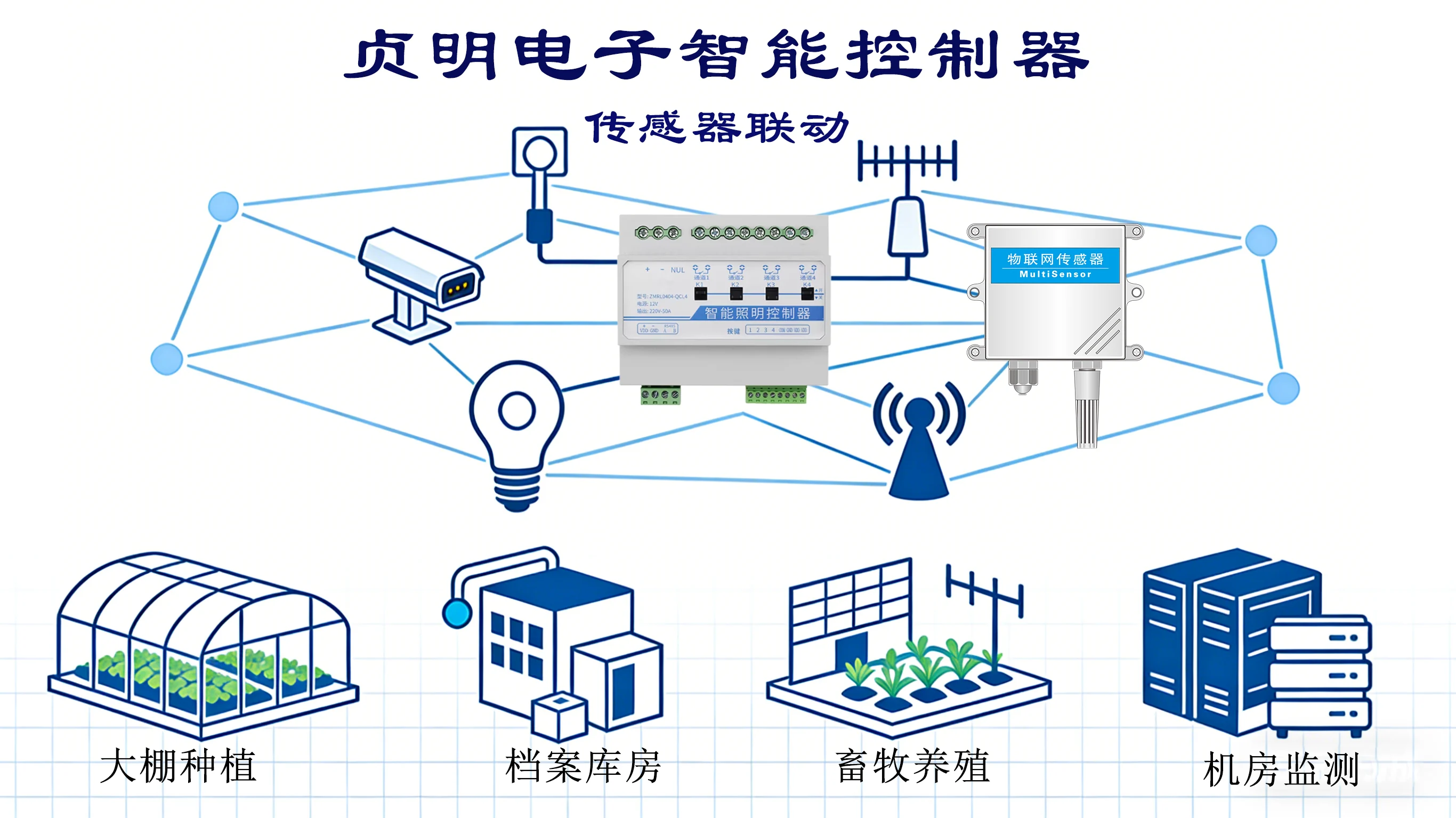
Zhenming controller and RS485 sensor local automation architecture
Local execution handles time-sensitive field actions; the platform handles configuration, records and operations.

Use local execution and platform management together

For supported devices, downloaded sensor rules can be evaluated by the controller without a cloud round trip. The platform remains responsible for rule configuration, status, alarms, logs, remote actions and cross-site maintenance.

Select power acquisition by the management objective

Three-phase smart meterUse for voltage, current, power, energy and power-factor metering at distribution or equipment circuits.
Multi-circuit acquisitionUse when several branch circuits must be compared, grouped or included in energy reports.
Power quality analysisUse when harmonic, disturbance and supply-quality analysis is part of the operating objective.
Platform recordsCombine energy data with device status, schedules and alarms for operational review.

Product combination

Network relay controllersSwitch circuits, read digital inputs and execute local or remote control.View capability
Environment sensorsProvide temperature, humidity, gas and other field values for monitoring and local rules.View capability
Energy acquisitionCollect three-phase or multi-circuit power data for reports and abnormal-condition review.View capability
IoT platform and APIOrganize devices, schedules, logs, alarms and customer-system integration.View capability

Selection workflow

1. Field inventoryList controlled equipment, circuits, signals, meters and existing systems.
2. ArchitectureSeparate local execution, communication access, platform functions and interfaces.
3. Device selectionMatch IO, controller, sensor, meter, gateway and platform by verified requirements.
4. Acceptance definitionDefine point list, actions, alarms, offline behavior, records and maintenance ownership.

Selection FAQ

Should a distributed project use RS485, Ethernet, 4G or LoRa?

Use RS485 for short, managed field buses; Ethernet where a reliable local network is available; 4G for independent distributed points; and LoRa for low-rate sensor points through a suitable gateway. Confirm distance, data volume, latency, power and maintenance conditions before selection.

When should automation run locally instead of in the cloud?

Safety-related or time-sensitive field actions such as ventilation, pumps, valves, lighting and alarms are better executed locally when the selected controller supports the required rules. The platform can manage configuration, records, cross-site visibility and maintenance.

When is a three-phase smart meter sufficient?

A three-phase meter is suitable when the objective is voltage, current, power, energy and power-factor visibility. Use a power quality device when the project also requires harmonic and disturbance analysis.

Can Zhenming devices connect to an existing PLC, HMI or SCADA system?

Integration can be planned with RS485 Modbus RTU, Modbus TCP, HTTP, MQTT, TCP or UDP according to the selected device. Define the point list, direction, refresh interval, exception handling and commissioning boundary before implementation.

What should be confirmed before requesting a selection?

Prepare the circuit and point count, signal types and ranges, communication distance, network and power conditions, installation environment, required local logic, platform deployment model and target system interfaces.