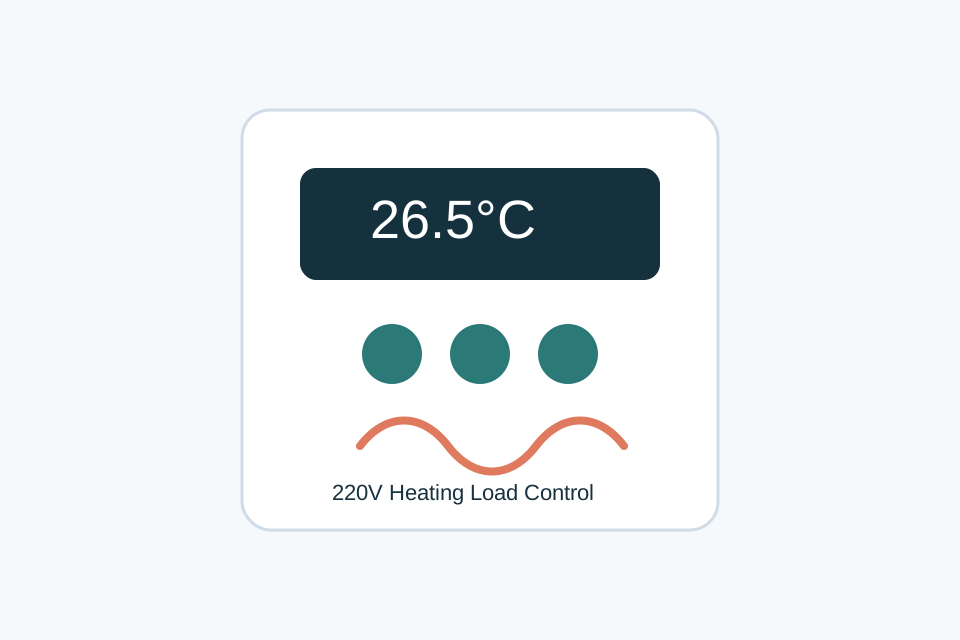
01Local temperature sensing and heater regulation
The controller regulates compatible resistive heating loads around a temperature setpoint. Its probe measures the heated area and the controller adjusts AC output for heat lamps, incandescent or halogen lamps and resistance heaters. Place the probe so that it represents the managed zone rather than only the hot surface of a lamp.
02Match local settings to the thermal process
Setpoint, temperature offset, adjustment period and output ratio shape the heating process. Tune them for the zone volume, lamp arrangement and ventilation, then review the observed temperature response. Display resolution and setpoint increments describe readout and adjustment granularity; they do not by themselves define the complete system’s control accuracy.
03Combine local heating control with farm management
The thermostat primarily performs local heating control at one point. Separate environmental sensors and network controllers can add barn-level temperature, humidity, ammonia or ventilation visibility. Multi-zone projects can combine the appropriate 0–10V module, compatible power drivers and a platform. Keep measurement, local regulation and remote management roles distinct.